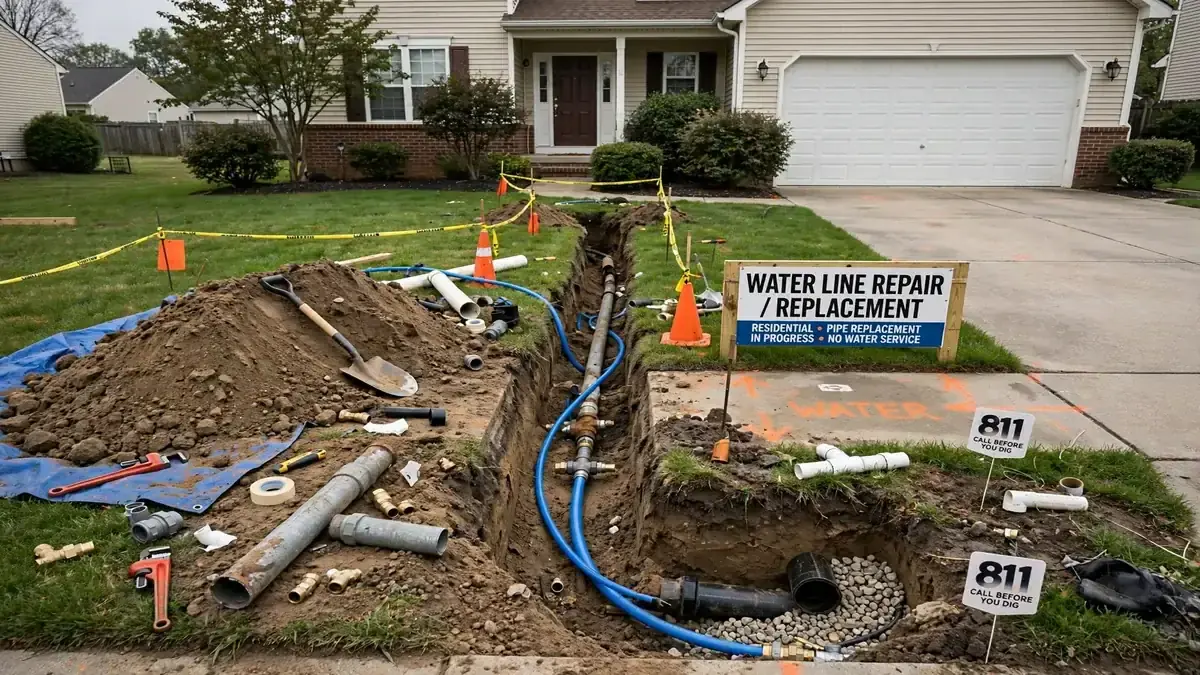
The water service line is the buried pipe that brings water from the meter to your house. When it breaks, you may see a soggy spot in the yard, hear water running or lose pressure entirely. Shut off the valve at the house, call our emergency line, which is open 24/7, and we schedule a licensed plumber.
Water line repair is the diagnosis and repair of that buried line. A spot repair fixes a single break. Replacement swaps the whole line when the pipe is old, corroded or damaged in several places.
When a Broken Service Line Is an Emergency: Signs to Watch
The line is out of sight, so the signs show up elsewhere.
- A wet or sunken area in the yard when it has not rained.
- Low pressure or no water at all.
- A meter that spins when everything inside is off.
- A sudden spike in the water bill.
- The sound of water running near the meter or foundation.
Check the meter first. If the dial moves with every fixture shut, the leak is on your side of the meter. A leak that turns up under the house is a slab leak question, and one in a larger yard near Experiment is covered on our Experiment page.
Who Is Responsible: City or Homeowner
In general, the utility maintains the line up to the meter and the owner maintains the line from the meter to the building. Policies vary, so call City of Griffin customer service and ask where the dividing point sits at your address. If the leak is before the meter, they handle it. If it is after, it is yours, and we repair it.
Old Pipe Materials Under Georgia Yards
Older service lines may be galvanized steel, copper or early plastic. Galvanized rusts through, copper pits and early polybutylene fails at fittings. Any of these may break or leak after decades underground.
Clay soils shift as they dry and swell, and that movement stresses pipe joints. A line that has broken once may break again, which is why we look at the condition of the whole run before we recommend a repair. Leak detection can help when the break is not obvious.
Water line broken?
Shut off the valve at the house and call the 24/7 line.
Spot Repair, Trenchless and Replacement
A short break can be fixed with a spot repair, where we dig to the break and replace a section. If the whole line is failing, we replace it, sometimes with a trenchless method that pulls a new line along the old route with minimal digging when the ground and layout allow.
Spot repair
- One leak, rest of line in good shape.
- Smaller excavation.
- Lower upfront cost.
- Rest of the line keeps its age.
Line replacement
- Multiple leaks or failing pipe.
- Longer service life.
- May use trenchless methods.
- Better when the line is decades old.
Utility Locates and Safety
Before we dig, we call 811 so buried gas, electric and communication lines are marked. That is required in Georgia and protects everyone. We also protect landscaping and driveways as best we can, and we tell you what restoration is part of the job.
Codes and Utility Rules for Service Lines
The standard for water service piping is the plumbing code, and the utility's rules decide where its responsibility ends at the meter. Georgia's state minimum plumbing standard is built on the International Plumbing Code (IPC), with Georgia amendments published by the Georgia Department of Community Affairs, and local governments can add their own rules.
Georgia 811 marks buried utility lines before any digging, and a licensed plumber arranges the call for excavation work.
What Water Line Repair Costs
Length, depth and surface decide it
We tell you what the repair needs and the price before we dig.
Insurance may cover water damage but often excludes the buried line itself unless you added a service line endorsement. Ask your insurer.
Questions homeowners ask
Yes. We answer 24/7 and schedule the first available licensed plumber.
Look at the house or in the meter box. Call us if you cannot find it.
Yes. Georgia requires locates before excavation, and we handle it.
Usually only up to the meter. Call City of Griffin customer service to confirm.
Sometimes. Trenchless methods help when the route and soil suit it.