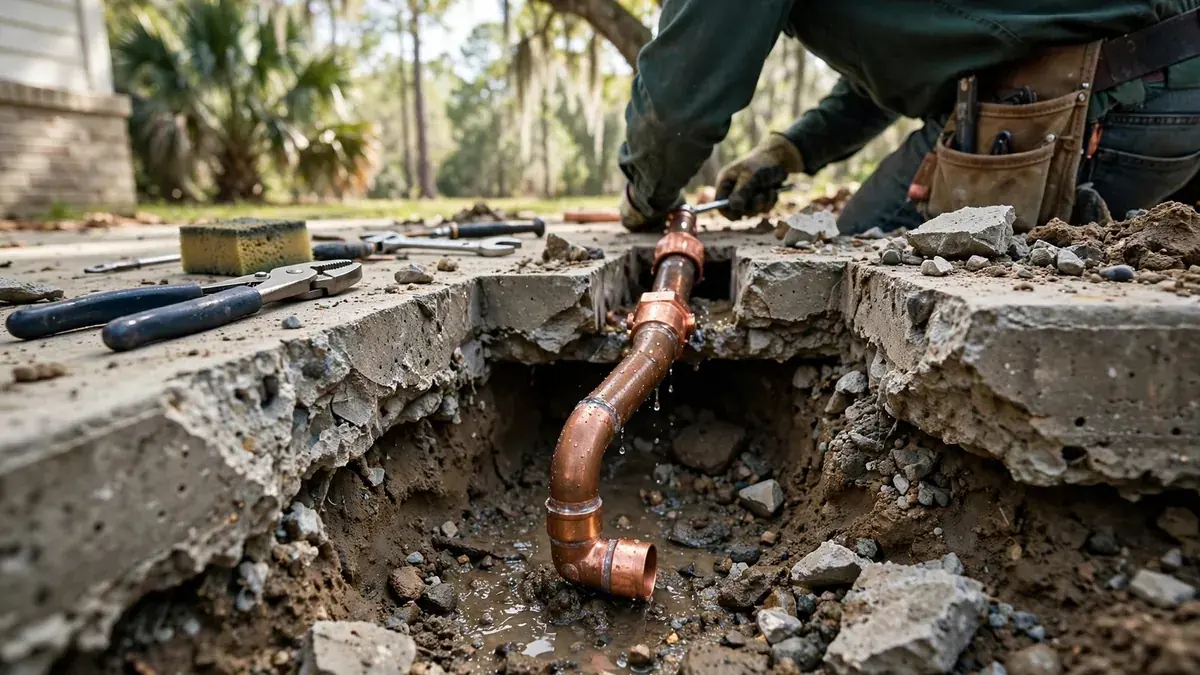
A slab leak is a leak in a water supply line that runs under or inside a concrete foundation. If you suspect one, shut off the main water valve, then call our emergency line, which is open 24/7. Stopping the water protects flooring and stops the bill from climbing while we schedule a licensed plumber.
Slab leak repair starts with locating the leak using listening equipment, pressure tests and thermal tools, then fixing it by opening the slab at the marked spot, rerouting the line through the attic or walls, or replacing the damaged section.
When a Slab Leak Is an Emergency: Signs to Watch
These signs often show up together.
- A warm or hot spot on the floor, often from a hot water line.
- The sound of water running when everything is off.
- The meter keeps moving after all fixtures are shut.
- A sudden jump in the water bill with no change in use.
- Damp carpet, buckled wood or cracked tile with no obvious source.
- Low water pressure or the water heater running constantly.
A single sign is a reason to investigate. Several signs together point strongly to a leak under the slab.
Why Slab Lines Leak
Copper lines under slabs can pit from aggressive water or rub against rock and concrete as the house settles. Older galvanized lines corrode. Poor backfill or sharp aggregate can wear a hole in a pipe over time. Hot water lines tend to fail sooner because heat expands and stresses the pipe.
Georgia clay moves with wet and dry cycles, and that movement can strain lines. We look at where the leak is and what the pipe around it looks like before we choose a repair.
How We Find It Without Tearing Up the Floor
We start with a meter test and a pressure test to confirm a leak and learn which line is affected. Then we use acoustic listening to pinpoint it and, if needed, thermal imaging to see a heated line. The slab is opened only at the marked spot. Our leak detection page explains the tools in more detail.
Suspect a slab leak?
Shut off the main and call the 24/7 line. We find it before we cut.
Your Repair Options
There are three common approaches, and the right one depends on how many leaks the line has and how long the run is.
Spot repair through the slab
- Open the slab at the leak and replace the section.
- Fastest for a single leak.
- Needs floor covering removed above the spot.
- Pipe elsewhere keeps its age.
Reroute the line overhead
- Abandon the slab line and run new pipe through walls or attic.
- Best when the line has multiple leaks.
- Avoids concrete cutting.
- Needs wall access and patching.
A third option is replacing the entire line, which is a repiping job. We explain all three and give a clear price for each so you decide with the numbers in front of you.
Permits and Insurance
Work that opens a slab or reroutes supply lines may need a permit. Call the City of Griffin Permits Division at (770) 233-4130 or Spalding County Community Development at (770) 467-4280 and we confirm what applies. Insurance may cover resulting damage from a sudden leak, but policies differ on tear-out and the pipe itself, so ask before work starts.
Standards for Slab and Supply Line Repairs
Opening a slab or rerouting supply lines is permit-sensitive work. Georgia's state minimum plumbing standard is built on the International Plumbing Code (IPC), with Georgia amendments published by the Georgia Department of Community Affairs, and local governments can add their own rules.
For a permit question at a Griffin address, call the City of Griffin Permits Division at (770) 233-4130, and for unincorporated Spalding County call Community Development at (770) 467-4280.
What Slab Leak Repair Costs
Locate first, then price the repair
You get one price for finding the leak and another for each repair option.
Some policies cover access to a leak and resulting damage, others do not. Keep our written leak report and photos for your claim.
Questions homeowners ask
Yes. We answer 24/7 and schedule the first available licensed plumber.
We run a meter test, a pressure test and acoustic listening to confirm and pinpoint it.
Not always. Rerouting avoids it, and spot repair opens only the marked area.
Call us. A hidden leak under the slab or in the yard is a likely cause.
Shut off the main if you can and use it only when necessary until the plumber arrives.