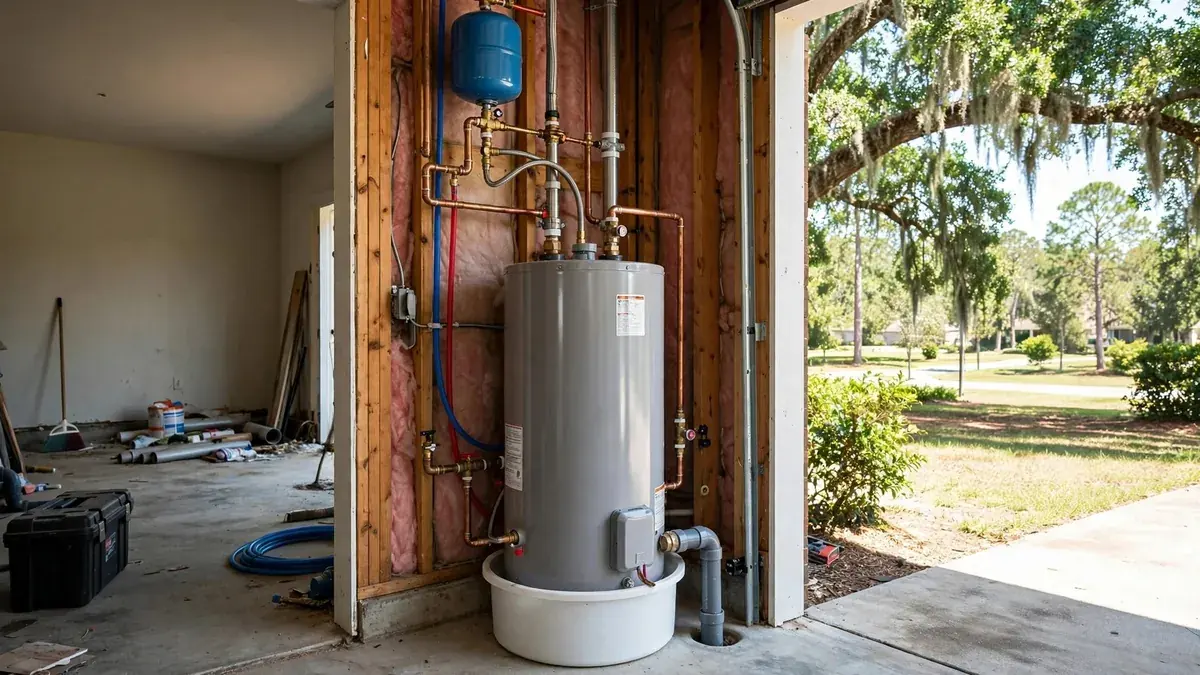
Water heater installation in Griffin, GA covers choosing a unit, preparing the space, connecting water, gas or electric supply and venting, and testing the system. Doing it on your schedule beats doing it at midnight with a flooded garage.
If your heater has already failed, start with emergency water heater replacement. This page is for planned work: remodels, new additions, a fuel change or an upgrade you have been considering.
Sizing the Heater to the House
Sizing starts with how many people shower at once and what runs at the same time. A tank sized for a couple will disappoint a family with teenagers, and a tank sized too large wastes energy keeping extra water hot.
| Household | What to consider | Typical direction. |
|---|---|---|
| One to two people | Few overlapping uses | Smaller tank or compact tankless. |
| Three to four people | Morning shower overlap | Mid-size tank or tankless with capacity margin. |
| Five or more | Laundry and baths overlap | Larger tank, two units or high-flow tankless. |
| Home with a soaking tub | Large single draws | Check recovery rate before choosing. |
We confirm sizing on site because pipe runs, fixtures and the existing heater tell us more than a rule of thumb.
Gas, Electric or Hybrid
Gas heaters recover quickly and keep working during power outages if the pilot design allows. Electric heaters are simpler to vent and install. Hybrid heat pump heaters use less electricity but need clearance, airflow and a drain for condensate.
If your gas appliance is served by Atlanta Gas Light, remember the utility's 24 hour number, 877.427.4321, for any gas smell during or after the job. A fuel change may mean a new gas line, a new circuit or both, and we price those separately and explain them first.
Planning an install?
Call for a clear price on your sized unit, with same-day scheduling when available.
Venting, Expansion Tanks and Relief Valves
Three parts quietly decide whether an install is safe. Venting carries combustion gases outside. A thermal expansion tank absorbs the pressure that rises when water heats in a closed system. A temperature and pressure relief valve discharges to a safe place if the tank overheats.
Many plumbers follow the International Plumbing Code or the plumbing code your jurisdiction adopted, plus the manufacturer's installation instructions. We follow the instructions printed with the unit and the local rules, and we show you where each safety part sits when the job is done.
Permits and Inspections in Griffin and Spalding County
Trade permits for plumbing, electrical and HVAC work inside Griffin must be obtained by licensed contractors, according to the City of Griffin. The Permits Division is at 100 S. Hill St., (770) 233-4130, Monday to Friday. For unincorporated Spalding County, contact Spalding County Community Development, (770) 467-4280.
We tell you when an install needs a permit and what the inspector will check. A homeowner who is not the licensed contractor should not pull a trade permit for this work unless the city's rules allow it.
Code References for a New Installation
Planned installs are where code questions come up most, from relief valve piping to venting clearances. Georgia's state minimum plumbing standard is built on the International Plumbing Code (IPC), with Georgia amendments published by the Georgia Department of Community Affairs, and local governments can add their own rules.
The manufacturer's installation instructions printed with the equipment are part of the standard an inspector reads against. For a gas smell, leave the building and call Atlanta Gas Light at 877.427.4321 or 911 from outside.
What Water Heater Installation Costs
A written plan before work starts
We walk the space and tell you the price before we order the unit.
Homeowners insurance generally does not pay for a planned upgrade. Ask your insurer whether a new heater changes your premium, and call us for your number.
Questions homeowners ask
Most tanks last well over a decade, but age is a guide and not a promise. Plan when your tank passes ten years or begins to show rust and noise.
Yes, though moving a gas or vented unit changes the gas line, venting and sometimes the floor drain. We price relocation separately.
Yes. We connect heaters for builders and homeowners and coordinate with inspections. See plumbing installation for the broader scope.
Open space around the unit, airflow, a drain for condensate and a dedicated electrical circuit. We check the room before recommending one.