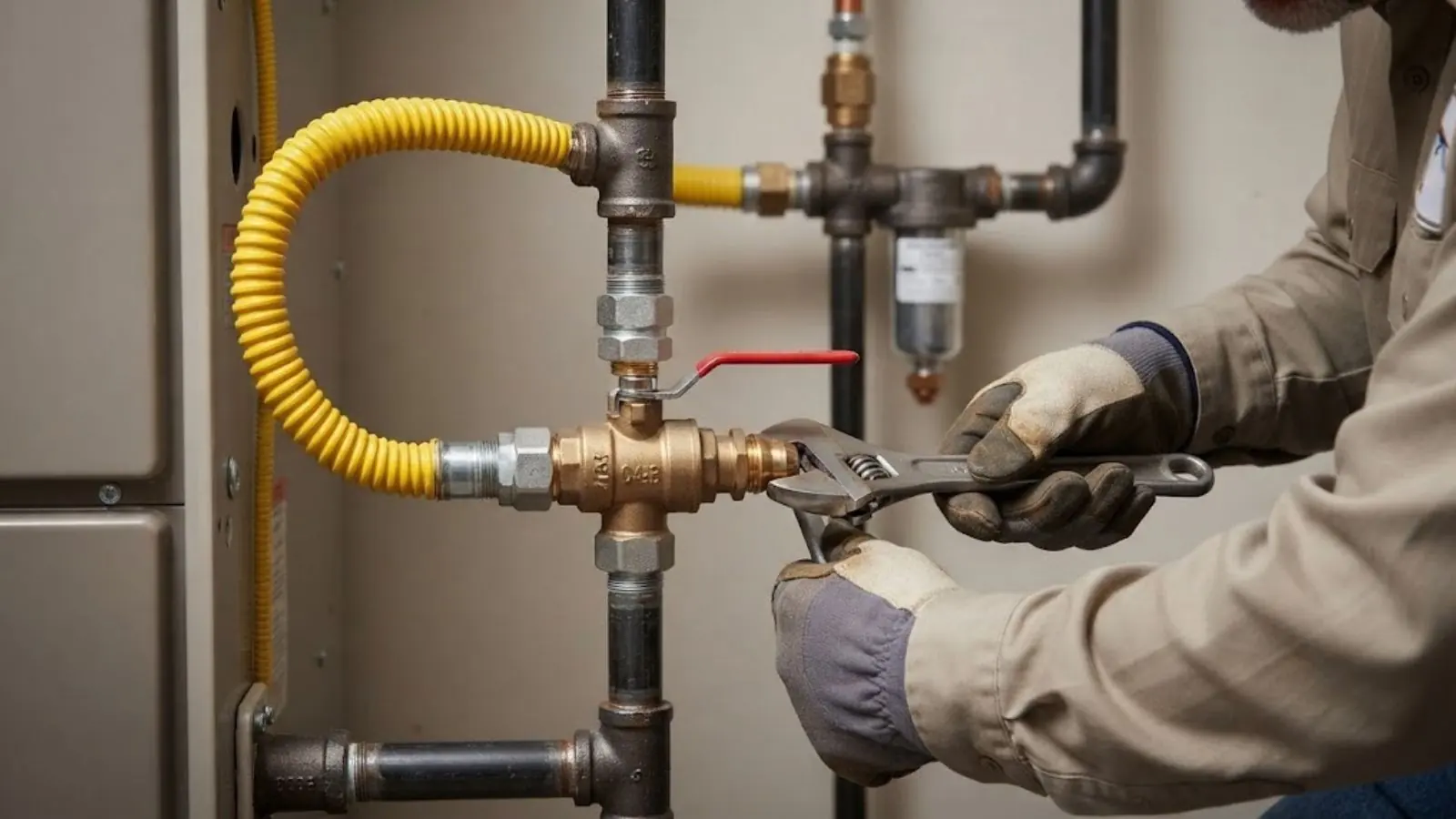
A gas tankless water heater fires a large burner only when hot water is running. That burner pulls far more gas for a short time than a storage tank does, so the existing gas line that served your old tank often is not big enough. Asking about the gas line before you buy a unit saves a surprise on installation day.
This guide explains what the gas line has to carry, how plumbers size it and what other work usually comes with the switch. If you are planning a tankless install, our tankless water heater page covers the broader service.
Why Tankless Needs More Gas
A tank heater heats forty or fifty gallons slowly over time with a modest burner. A tankless unit has to raise the temperature of water as it flows, so the burner is rated in tens of thousands of BTUs more. That demand arrives instantly, and the line has to deliver it without a pressure drop.
If the line is undersized, the unit may shut down on a high flow, throw an error code or cycle on and off. Ignition problems and weak flames are common symptoms of a gas supply that cannot keep up.
How a Gas Line Is Sized
Sizing depends on four things: the total BTU demand of every gas appliance on the line, the length of the run from the meter, the pipe material and diameter, and the gas pressure. Plumbers use published sizing tables for the fuel and pipe type, and they add up the load of the furnace, range, dryer and heater together.
| Factor | Why it matters | What we check. |
|---|---|---|
| Appliance load | All appliances can run at once | BTU ratings on every gas appliance. |
| Run length | Longer runs lose pressure | Distance from meter to heater. |
| Pipe size | Larger pipe carries more gas | Existing diameter and material. |
| Supply pressure | Low pressure starves the burner | Pressure at the meter and the unit. |
Plumbing problem right now?
Call the 24/7 line and a licensed plumber is scheduled for the first available slot.
What the Switch Usually Involves
Beyond the gas line, a tankless install often needs new venting, since the flue from an old tank may not suit the new unit. Condensing models need a drain for acidic condensate. Some units need an electrical outlet nearby. A plumber walks the path from the meter to the heater and lists what changes.
- A larger or rerouted gas line from the meter or a tee point.
- New sealed or special venting through a wall or the roof.
- A condensate drain and neutralizer for high efficiency models.
- A nearby outlet and sometimes a shutoff valve upgrade.
- A permit and inspection where required.
Ask for each item as a separate line in the quote so you can see what the gas work costs and what the unit costs.
Gas Safety Basics
Gas work is not a do-it-yourself job. Fittings need leak testing, and an undersized or leaking line is a real hazard. If you ever smell gas, leave the house and call from outside. We pressure test our connections and explain the result before we leave.
A tankless heater is also an electronic appliance. Error codes, an inlet screen that clogs and scale on the heat exchanger are common service items, covered on our water heater installation page.
Questions to Ask Before You Buy a Unit
The most useful conversation happens before the purchase. Ask the plumber to calculate the gas load for every appliance in the house, to measure the run from the meter and to say in writing whether the existing line is adequate. A seller who quotes you a unit without asking about your gas piping is skipping the step that causes the most trouble.
- What is the total BTU load with the new unit added?
- Is the existing pipe size and length enough, and how was that calculated?
- Does the utility need to upgrade the meter or service line?
- Where does the vent go, and what does it cost?
- What is the plan for the condensate drain?
- Which parts of the quote are gas work and which are the heater?
Propane and Natural Gas Are Not Interchangeable
Some homes outside the city run on propane from a tank. Propane and natural gas have different pressures, different orifices and different pipe sizing, and a tankless unit must be set up for the fuel it will burn. A conversion kit exists for many models, but the sizing math changes, so tell the plumber which fuel you have.
If you are comparing a gas tankless against a hybrid electric heater, that is a different project with different needs. Our water heater installation page walks through the options.
What Installation Day Looks Like
A tankless install usually takes most of a day. The old tank is drained and removed, the new unit is mounted on the wall, the gas line is run and tested, the vent is connected, water lines are tied in with isolation valves, and the condensate line is routed to a drain. The unit is started, error codes are checked, and the plumber measures flow and temperature at a fixture.
Isolation valves are worth asking about. They let a plumber flush scale out of the heat exchanger later without cutting pipes, and they make future service quick.
Sizing Standards for Gas Piping
Gas pipe sizing uses published tables for the fuel and pipe type, and the tankless maker's installation guidelines list the required input. Georgia's state minimum plumbing standard is built on the International Plumbing Code (IPC), with Georgia amendments published by the Georgia Department of Community Affairs, and local governments can add their own rules.
Natural Gas Service in Griffin
Natural gas in Griffin is delivered through Atlanta Gas Light's distribution system, and the utility's 24 hour emergency number is 877.427.4321. If you smell gas, leave the building and call that number or 911 from outside before you call a plumber. Questions about meter capacity or service line size go to the gas utility, and appliance gas piping inside the house is the plumber's work.
City of Griffin trade permits for plumbing and gas work must be pulled by licensed contractors, and the Permits Division is at (770) 233-4130. For unincorporated areas of Spalding County, call Community Development at (770) 467-4280.
Homes north of the city limits are covered on our Experiment emergency plumbing page, and our service areas page lists the other towns we reach.
Griffin questions answered
Sometimes. It depends on the pipe size, run length and other gas appliances. A plumber calculates it before quoting.
For meter or service line capacity, yes. Ask the utility. For piping inside the house, a licensed plumber handles it.
Yes. The orifice, pressure and pipe sizing differ. Tell us which fuel you have.
Leave the house and call Atlanta Gas Light at 877.427.4321 or 911 from outside.
It gives hot water as long as the unit keeps up with the flow. Sizing matters.