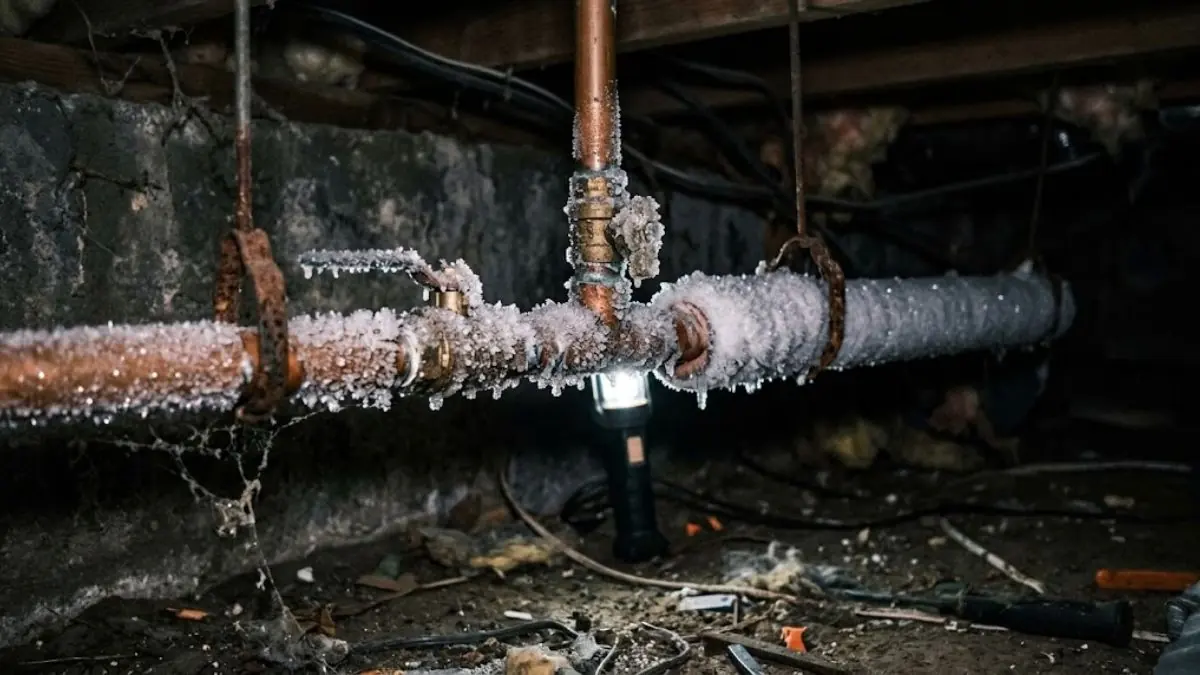
Georgia does not get long winters, but hard freezes happen, and homes built with pipes in attics, crawlspaces and exterior walls are not ready for them. Ice blocks the pipe and then expands and can split it. The leak often starts only when the ice thaws.
This guide covers how to find a frozen pipe, how to thaw it without making things worse and what to do if it has already split. If water is flooding, skip to emergency burst pipe repair and call.
How Pipes Freeze
Water expands as it turns to ice. If it freezes inside a pipe, pressure builds between the ice and a closed faucet and can split the pipe or pop a fitting. Pipes most at risk run through unheated spaces such as attics, crawlspaces, garages and exterior walls, and outdoor spigots and irrigation lines.
A short hard freeze is the usual culprit, not a long cold spell, especially when wind blows through a gap in the foundation.
Signs a Pipe Is Frozen
The first sign is usually a trickle or no water from a faucet in cold weather.
- Only a trickle comes from one tap while others work.
- Frost on a visible pipe in a garage or crawlspace.
- A bulge or crack in a pipe or fitting.
- Strange smells from a drain, which can mean a frozen drain line.
- No water anywhere, which may mean the service line outside froze.
If a pipe has split, you may see water only after it thaws. Watch the area carefully.
Plumbing problem right now?
Call the 24/7 line and a licensed plumber is scheduled for the first available slot.
Thawing Safely
Open the faucet so melting ice has a path out. Warm the pipe slowly with a hair dryer on low, a heating pad or warm towels, starting near the faucet and working back toward the frozen spot. Never use an open flame, a torch or a heater left unattended, since pipes can scald or ignite nearby material.
Open the tap
Let thawing water and steam escape so pressure does not build.
Warm slowly
Use a hair dryer or heating pad, working from the faucet back.
Check for leaks
Once water flows, inspect the whole length of the pipe.
If the Pipe Has Split
Shut off the main water valve at once and drain the lines by opening faucets. Switch off power to wet areas from a dry spot. Take photos for your insurer and call us. Repair means cutting out the split section and installing new pipe, and we check the rest of the run for damage. For a service line outside the house, see water line repair.
Preventing Freeze Damage
Insulate exposed pipes in attics and crawlspaces, seal drafts near pipes, disconnect and drain garden hoses and let faucets drip on the coldest nights. Know where your main shutoff is before a freeze, and keep cabinet doors open under sinks on exterior walls so warm air reaches the pipes.
Where to Look First in Your House
Start with the places that have the least heat. Check pipes in the crawlspace, the attic, the garage and the exterior walls of kitchens and bathrooms. Look for frost, bulges and wet spots. Feel the pipe: a frozen section is much colder than the rest.
If a faucet on an exterior wall is not working, the pipe behind it is a prime suspect. Open the cabinet doors under that sink and let warm air reach the wall. Do not cut into walls yourself, because a split pipe behind drywall needs a plumber's tools and the right shutoff.
Insulation That Actually Helps
Foam pipe sleeves are inexpensive and easy to fit on exposed pipes. Seal gaps where pipes pass through walls and floors, because small drafts do more damage than a cold room. In a crawlspace, close vents on the coldest nights and repair broken access doors.
Heat tape is available for specific uses, but follow the instructions and replace worn tape. Never overlap it. Our burst pipe repair page explains what we do when prevention falls short.
Outdoor Spigots and Irrigation
Disconnect hoses before a freeze, since a hose holds water against the spigot and invites ice. Frost-proof sillcocks have a long stem that places the valve inside the heated wall, and they are a worthwhile upgrade. Irrigation systems should be drained or blown out before a hard freeze.
If you find a wet wall near a spigot after a freeze, shut off the line and call. For homes in Experiment or elsewhere in the county, see our service areas page for coverage.
Guidance for Freeze Season
Insulation and freeze protection follow the pipe maker's guidelines and the plumbing code for exposed lines. Georgia's state minimum plumbing standard is built on the International Plumbing Code (IPC), with Georgia amendments published by the Georgia Department of Community Affairs, and local governments can add their own rules.
Georgia 811 marks buried utility lines before any digging, and a licensed plumber arranges the call for excavation work.
Griffin Freezes, Meters and 811
If a freeze breaks a buried water line, the repair involves digging, and Georgia 811 must mark underground utilities first. The meter and the line to the house are your responsibility after the meter, and the City of Griffin customer service line can tell you where your property line sits. If you cannot find your shutoff in an emergency, call the city and call us.
Experiment homes may have a different provider, and our Experiment emergency plumbing page lists how we respond there. We answer 24/7.
Griffin questions answered
Yes, a slow drip on the coldest nights keeps water moving and can help prevent freezing.
Yes. The split often shows up only when the ice melts, so check the pipe as it thaws.
Call City of Griffin customer service for the meter and call a plumber for your side of the line.
Often it covers sudden damage, but terms differ. Keep photos and call your insurer promptly.
Yes. Our emergency line is open 24/7.