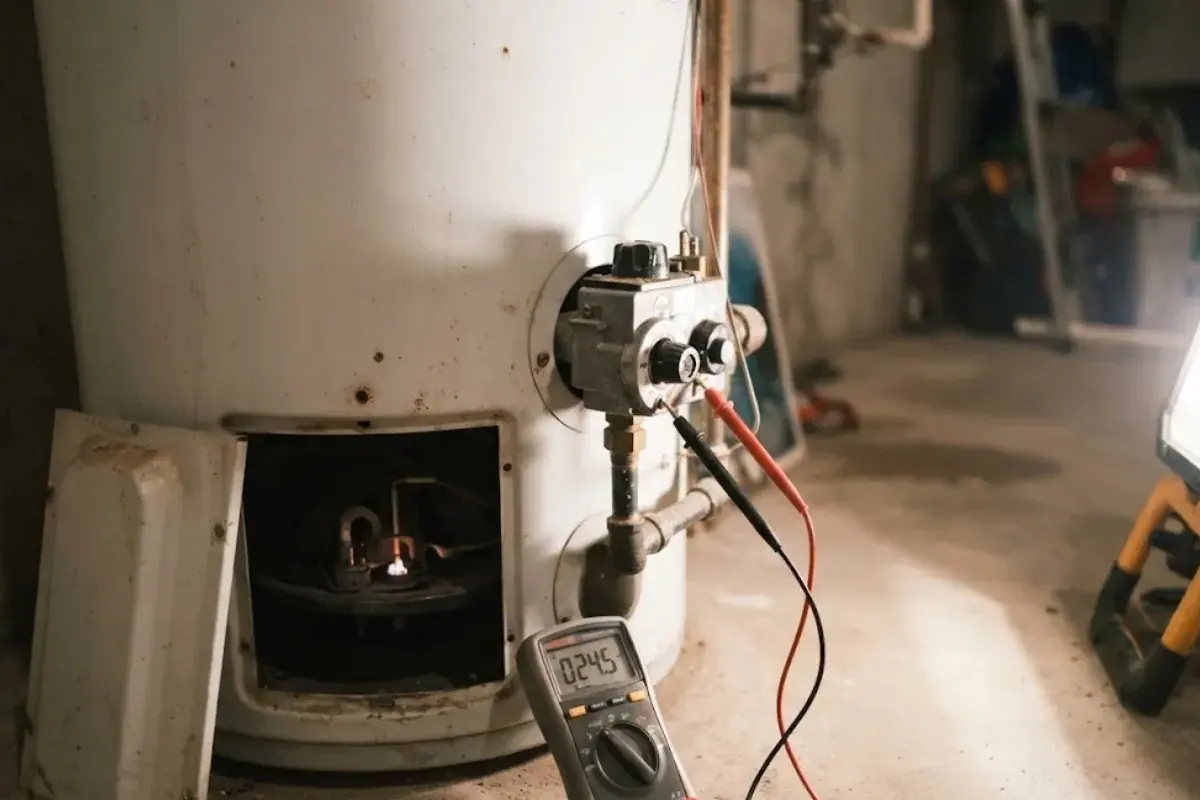
An electric water heater makes hot water with two heating elements, one near the top of the tank and one near the bottom. When one fails, the water runs lukewarm, runs out fast or never gets hot. Element replacement is one of the most common electric water heater repairs, and on a sound tank it is a short job.
This guide explains how elements fail, how to tell a bad element from a bad thermostat or a leaking tank, and when replacing the element makes sense compared with replacing the whole heater. If the tank is leaking, skip ahead and call, because no element swap fixes a leak.
How the Two Elements Work
The upper element heats the top of the tank first and then hands off to the lower element, which keeps the rest of the water warm. Each element has its own thermostat. Because they take turns, a failure in one shows up in a specific way.
| What you notice | Likely cause | What it means. |
|---|---|---|
| Water is warm but never hot | Failed lower element | Smaller hot supply, runs out quickly. |
| No hot water at all | Failed upper element or thermostat | Neither element can heat. |
| Breaker trips on reset | Element shorted to ground | Needs repair before power returns. |
| Hot water runs out fast | Sediment or a weak lower element | Flush the tank and test elements. |
| Water leaks from the tank | Failed tank liner | Replace the heater. |
Signs an Element Has Failed
Most people notice shorter showers first. A household that used to get a full tank of hot water now gets half. Others hear a sizzling sound as mineral scale burns on the element surface, or see a breaker that trips every time the heater tries to run.
- Showers go cold sooner than they used to.
- Water only reaches lukewarm.
- The heater makes a sizzling or popping sound.
- A breaker trips and trips again after resetting.
- The electric bill climbs while hot water gets worse.
A plumber tests each element for continuity and checks that it is not shorted to the metal tank. That test takes minutes and tells us whether the part is worth replacing.
Plumbing problem right now?
Call the 24/7 line and a licensed plumber is scheduled for the first available slot.
Why Elements Burn Out
Heat cycles wear elements, and minerals in the water coat them in scale. Scale acts like insulation, so the element runs hotter and fails sooner. Sediment on the bottom of the tank buries the lower element and makes it overheat.
A tank that has been in service more than ten years may have scale and sediment throughout. Replacing an element in an old tank can work, but the new element faces the same conditions, so we tell you honestly whether the tank is worth the repair. Our water heater repair page explains how we make that call.
Repair or Replace the Whole Heater
If the tank is dry, intact and under about a decade old, an element is a smart repair. If the tank leaks, rusts at the seams or is well past ten years, put the money toward a new unit. Parts are cheap compared with a flood.
Replace the element
- Tank is dry with no rust at the seams.
- Age is under about ten years.
- Breaker and thermostat test fine.
- Quick repair, same-day often.
Replace the heater
- Water at the base of the tank.
- Heater is past ten years.
- Repeated element failures.
- See water heater replacement.
Safety Checklist Before Anyone Touches the Tank
Turn off the breaker for the heater and confirm the power is off with a tester before opening an access panel. Water and electricity do not mix, and a heater can hold enough hot water to scald. If you are not comfortable with electrical work, call a licensed plumber. Never run an element dry, because it burns out within minutes.
What a Plumber Does During an Element Repair
The visit follows a set order so nothing is missed. The plumber shuts off the breaker and confirms the power is dead. Next the cold inlet is closed and enough water is drained to lower the level below the element. The access panel and insulation come off, and each element and thermostat is tested for continuity and for a short to ground. Only then is a part swapped.
After the new element goes in, the tank is refilled completely before power is restored. That order matters, because an element energized in air burns out within minutes. The plumber then checks the thermostat settings, looks for leaks at the new gasket and measures the water temperature at a tap to confirm the unit is heating.
- Power off and verified with a tester.
- Tank drained below the element, with the cold inlet closed.
- Both elements and thermostats tested.
- New element and gasket installed, tank refilled before power returns.
- Temperature checked at a fixture.
Flushing the Tank While You Are Inside It
If the element failed because of sediment, replacing it without flushing invites the same failure. While the tank is already drained, a plumber can flush the bottom to remove loose sediment. That small step lowers noise, helps the lower element run cooler and slows the next failure.
Heavy sediment that does not flush out is a sign of an aging tank. We tell you what we see and give you the honest comparison between a repair now and a replacement soon. If you want the full picture of how we decide, our water heater repair page describes the checks, and our service areas page lists the towns we reach.
Thermostat Settings and Energy Use
A thermostat set too high wastes energy and speeds up scale. A setting around the manufacturer's recommended level is a good starting point, and many homeowners keep it lower for safety. Do not raise it to make up for a failing element, because the problem is the part, not the setting.
If your bill climbed before the heater failed, an element that was working poorly may have been to blame. Weak elements run longer and cost more to operate. Fixing the part often brings the bill back to normal.
Standards Behind Element Repairs
Element swaps follow the manufacturer's wiring and wattage guidelines printed on the heater's data plate, and the electrical connection falls under the electrical code. The manufacturer's installation instructions printed with the equipment are part of the standard an inspector reads against.
Electric Water Heaters in Griffin and Experiment
Water heater work inside the City of Griffin falls under trade permit rules, and the city says trade permits for plumbing and electrical work must be pulled by licensed contractors. The Permits Division at 100 S. Hill St. can answer questions at (770) 233-4130. Experiment is unincorporated, so permit questions there go to Spalding County Community Development at (770) 467-4280. Our Experiment emergency plumbing page covers how we serve that area.
A simple element swap on an existing heater is a repair, but confirm with your local office if you are unsure whether your job needs a permit.
Griffin questions answered
A plumber tests both. Failed elements read open or shorted, and failed thermostats do not switch the power on and off correctly.
It is possible for a handy homeowner, but it involves draining the tank and working with live circuits. A licensed plumber does it quickly and tests the result.
It varies with water and use. Scale and sediment shorten life, and flushing the tank helps.
A like-for-like element swap is repair work, but call the City of Griffin Permits Division at (770) 233-4130 or Spalding County Community Development at (770) 467-4280 to confirm for your address.