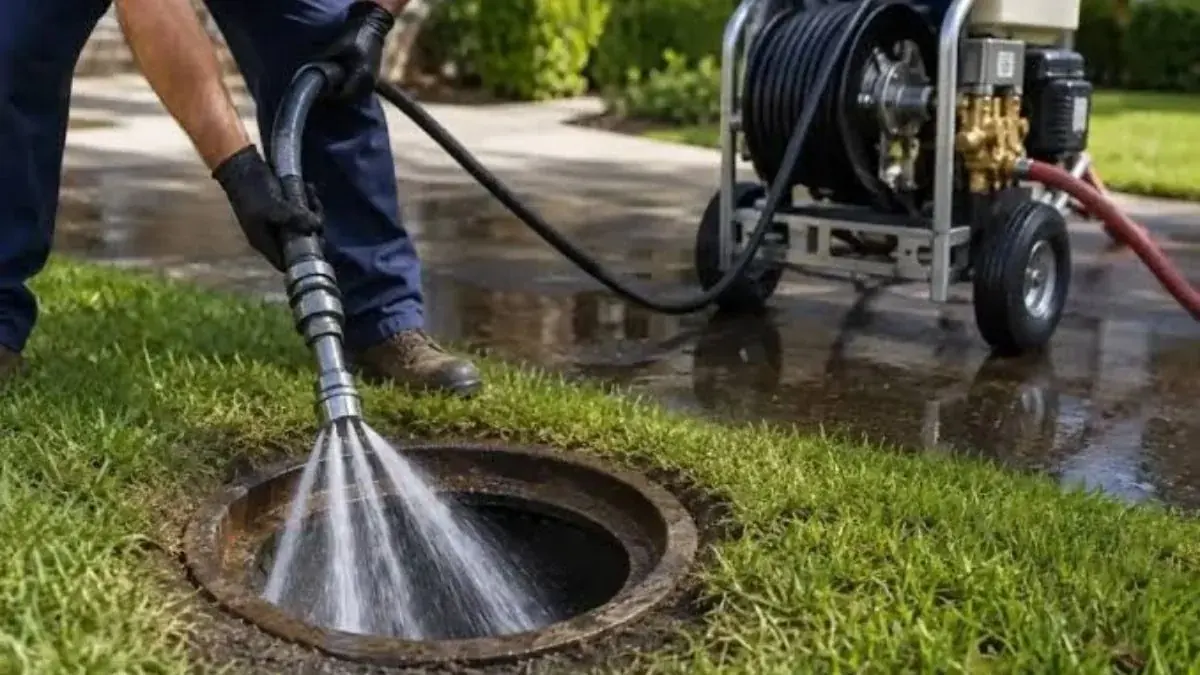
Hydro jetting uses pressurized water to scour a pipe clean, and it works very well on grease, scale and sludge. The question homeowners with older houses ask is whether it is safe for pipe that has been in the ground for fifty or eighty years. The answer is that it depends on the pipe, and a camera tells you.
This guide explains how plumbers decide, what pressure and nozzles do and what to do when the pipe is too fragile. Our hydro jetting page covers the service itself.
What Jetting Does Inside a Pipe
A jetting hose carries a nozzle that sprays water backward and sideways. The jets pull the hose forward and scour the wall. Grease dissolves, scale breaks loose and root hairs get cut back. Unlike a cable, the water cleans the whole circumference of the pipe.
Pressure and nozzle choice are adjustable. Light pressure and a gentle nozzle clean a fragile line, and heavy pressure and aggressive nozzles are for strong pipe in good condition.
Old Pipe Types and How They Age
Older Griffin homes can have several pipe types under or behind them.
| Pipe | How it ages | Jetting risk. |
|---|---|---|
| Cast iron | Rusts and scales inside, can crack | Often fine with moderate pressure if sound. |
| Clay | Joints open and roots enter | Joints can be damaged by heavy jets. |
| Orangeburg (bituminized fiber) | Softens and collapses | High risk, usually avoided. |
| PVC | Rarely corrodes | Low risk. |
Orangeburg is a fiber pipe used in some mid-century construction that softens with age, and jetting it is generally avoided.
Plumbing problem right now?
Call the 24/7 line and a licensed plumber is scheduled for the first available slot.
Why the Camera Comes First
A camera shows whether the pipe is intact, cracked, offset or collapsed. If it shows a break, jetting can wash soil into the pipe or widen a crack. If it shows scale and grease on a sound wall, jetting is the right tool. The video also gives you a record for planning a repair, and our sewer inspection page explains the process.
When Jetting Is Not the Answer
A bellied section holds water and will clog again no matter how clean the wall is. A collapsed section needs excavation or lining. A solid obstruction such as a broken fitting must be retrieved. For those, the fix is repair, not cleaning, as described on our sewer line repair page.
- Camera shows a crack or offset joint.
- Cable stops at the same distance every time.
- Pipe material is fiber or heavily deteriorated.
- Line has a belly that holds water.
- Repeat clogs return within weeks of jetting.
Gentler Alternatives
If the pipe is old but sound, a lower-pressure jet or a cable with a scraping head can clean it. A liner can rebuild a weak but straight pipe from the inside. If the pipe is failing, replacement is the long-term answer.
How a Camera Decision Plays Out
The camera visit usually goes one of three ways. The first is a sound pipe with heavy buildup, and jetting goes ahead at a pressure suited to the pipe. The second is a pipe with a defect, such as a crack or an offset, and the plumber recommends a repair before any heavy cleaning. The third is a collapsed or fiber pipe, and the answer is replacement or relining.
Having the video lets you see the same thing the plumber sees. You can make the decision with the facts in front of you instead of trusting a recommendation blindly. Ask for a copy of the recording.
Pressure and Nozzles in Plain Terms
Pressure is measured in pounds per square inch, and plumbers choose it to suit the pipe. Residential lines are usually cleaned at modest pressure. Commercial lines may use more. Nozzles differ too. A forward-facing nozzle punches through a blockage, and a rotating nozzle with side jets scours the wall.
Ask the plumber which nozzle and what pressure range they plan to use. A confident answer shows the plumber has thought about your pipe, and a vague one deserves a follow-up question. If you are in Experiment, see our Experiment page for how we handle older lines there.
After the Jet: Keeping the Line Clean
Jetting resets the pipe. Habits keep it clean. Keep grease out of the kitchen drain, use a strainer in tubs and showers, flush only paper and waste, and schedule a camera check if the line has a history. A line that was scoured clean may stay clear for years, while one with a belly or roots will return.
If a line clogs again soon after jetting, treat it as a signal. The camera should be repeated, since something is catching debris. Our sewer line cleaning team can recheck it.
Standards for Older Pipe Work
Pipe materials are rated by standards bodies, and repairs to old drains are held to the current plumbing code. Georgia's state minimum plumbing standard is built on the International Plumbing Code (IPC), with Georgia amendments published by the Georgia Department of Community Affairs, and local governments can add their own rules.
Georgia 811 marks buried utility lines before any digging, and a licensed plumber arranges the call for excavation work.
Griffin's Older Neighborhoods and Cast Iron
Mill-era streets and downtown blocks in Griffin were built long before PVC, so original drains may be clay or cast iron. We do not assume a pipe type without seeing it, and the camera is how we find out. If a repair needs digging, Georgia 811 must mark buried utilities first.
For permit questions on sewer work, call the City of Griffin Permits Division at (770) 233-4130, or Spalding County Community Development at (770) 467-4280 for unincorporated areas like Experiment.
Our service areas page lists the towns where we jet and camera-check older lines.
Griffin questions answered
On sound pipe at moderate pressure, usually not. On cracked or thin pipe it can. A camera tells which you have.
For heavy buildup, yes. For a simple clog, a cable is gentler and cheaper.
A bituminized fiber pipe used in some mid-century homes. It softens with age and is not a good candidate for jetting.
Look at exposed sections near the cleanout or in the crawlspace, or let a camera show it.
Yes, if the pipe suits it. Septic lines are different, and we tell you what applies.